Social Media & Chef Reputation: Hired Before a CV



There is a moment, and most chefs will recognise it even if they would rather not admit it, when you realise that being brilliant at cooking is no longer the thing that matters most. You have worked the sections, earned the stars, developed the muscle memory for a perfect beurre blanc at midnight, and then someone hands you a brigade of twelve, a set of quarterly figures, and a kitchen porter who has taken to crying in the walk-in. Suddenly your knife skills are not going to save you.
I spent years believing that if I could cook well enough, everything else would follow. It is a comforting thought and entirely wrong. The same skills that earn you a reputation in a kitchen, precision, obsession, and a refusal to compromise – can make you an absolute nightmare to manage people with. I know this because I was that nightmare for longer than I would like to confess.
Professional kitchens reward a very particular kind of excellence. You get faster, cleaner, and more consistent. You learn to taste a sauce and know in seconds what it needs. You read a service like a conductor reads a score. These are hard-won skills, and they deserve genuine respect. The trouble is, they are almost entirely personal skills. They live in your hands, your palate, your instincts.
Managing a kitchen, or a restaurant, or, God forbid, an entire business, requires something different. It requires you to get results through other people rather than from them. That is a shift in thinking that does not come naturally to most chefs, because most chefs have spent their formative years in environments that punish mistakes loudly and reward individual performance above almost everything else.
The old brigade system had its merits. Structure, discipline, and a clear chain of command. It also produced a generation of chefs who were technically superb and emotionally about as communicative as a stock cube. (I include myself in this, before anyone writes in.)
When you step into a leadership role, whether that is head chef, executive chef, or owner-operator, the job description changes fundamentally. You are no longer being paid primarily for what you can do. You are being paid for what the team can do, consistently, night after night, without you standing over every plate. That is a humbling realisation and a useful one.
The skills that fill the gap tend to fall into a few clear categories. Not soft skills, I have always disliked that phrase, as if empathy and communication are somehow less rigorous than julienning carrots. These are just skills. Different ones. Ones that take just as long to develop properly.
Here is the bit nobody likes to hear. A certain amount of ego is almost a prerequisite for getting to the top of any serious kitchen. You need to believe, with some conviction, that your food is good, your standards are right, and your judgement is sound. Without that, you waver at the pass, and the whole service wobbles. The problem is that ego, useful in a cook, is corrosive in a leader.
A leader who cannot admit they are wrong, or who takes every piece of feedback as a personal attack, creates a team that stops telling them the truth. And a team that stops telling you the truth is a very dangerous thing to be in charge of. You end up finding out what is wrong via a one-star review on a Tuesday morning, which is not ideal.
The chefs I have seen make the transition well are, almost without exception, the ones who stayed curious. They treated management the same way they treated cooking: as something to practise, get wrong, learn from, and gradually get better at. Not a set of instincts you either have or you do not, but a craft that rewards sustained attention.
Traditional culinary training, even the best of it, prepares you almost exclusively for being a skilled individual contributor. You come out knowing how to cook. You do not come out knowing how to run a team appraisal, manage a rota fairly, or have a difficult conversation with a sous chef who has started taking liberties with the Friday prep list.
Which means you have to go looking for that knowledge yourself. Some people find it through mentors (invaluable, if you can find one who is honest rather than just flattering). Some find it through proper management training, which need not be as dry as it sounds if you approach it with the same appetite you would bring to learning a new cuisine. Some find it by making expensive mistakes and having the good sense to learn from them rather than repeat them.
Reading helps, too. Not business books full of diagrams and jargon, necessarily, though some are worth the time. But biographies of people who have built and run things, whether kitchens or otherwise. History. Psychology. Anything that helps you understand why people behave as they do under pressure, because that is most of the job.
None of this means the cooking stops mattering. A head chef who has lost their palate, or their standards, or their genuine interest in what ends up on the plate cannot inspire a team to care about those things either. The craft is still the foundation. It just cannot be the whole building.
The best leaders I have worked under, and there were not many of them if I am honest, had that combination: serious technical knowledge that commanded respect and enough self-awareness to know that their job was to create the conditions in which other people could do their best work. They were not always easy people. But they were clear and consistent, and they genuinely gave a damn about the cooks coming up behind them.
That, more than any single management theory or leadership framework, is probably what it comes down to. The skills that got you here – your precision, your instincts, your refusal to accept a mediocre plate – remain essential. They just need company. Start building the rest before someone else points out that you needed it years ago.
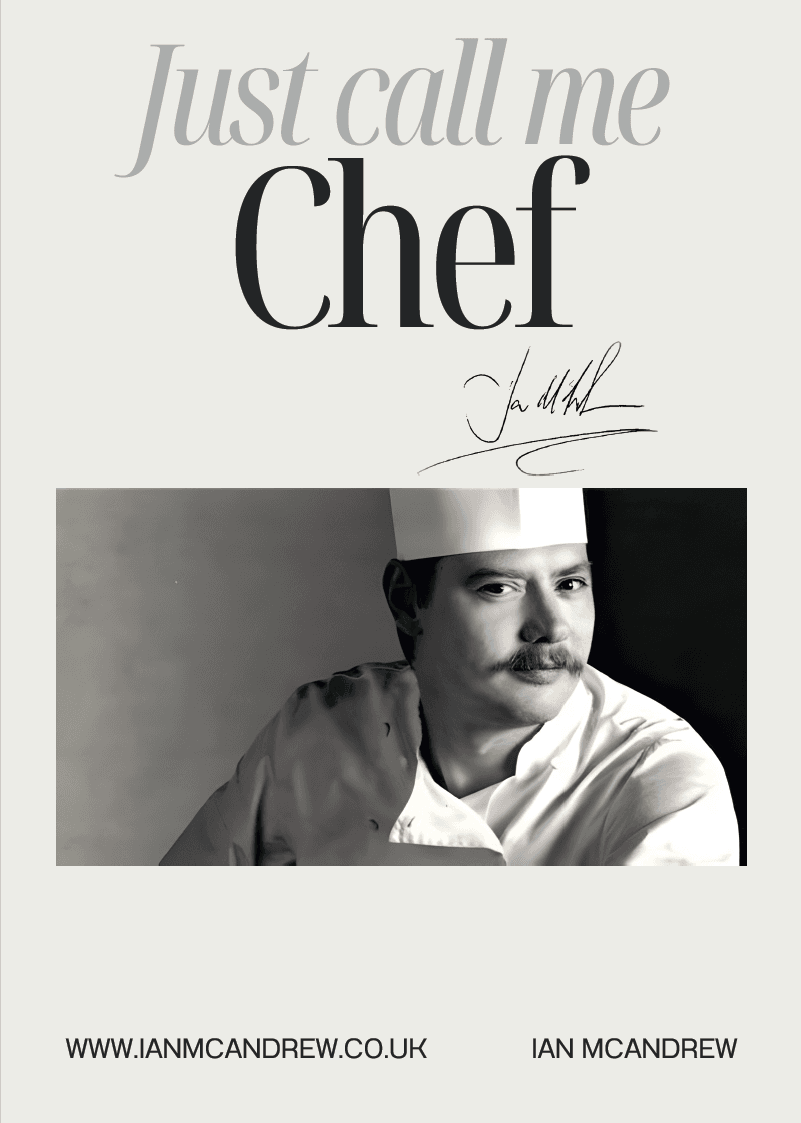
Chef Ian McAndrew’s specialist eBooks and guides are available directly on ChefYesChef, including his technical titles and autobiography. If you want more practical, chef-led reading beyond this article, you’ll find the full collection here.
Chef Ian McAndrew works with chefs, businesses, and individuals on a wide range of culinary projects, from concept development to practical problem-solving.
If you’d like to talk through an idea or need informed guidance, you’re welcome to contact him.
Essential cookies required for the site to function. Cannot be disabled.
Cookies that help us understand how visitors use the site.
Cookies used to deliver relevant advertisements.
Privacy Policy Terms of Service