Are we done with old school service ?



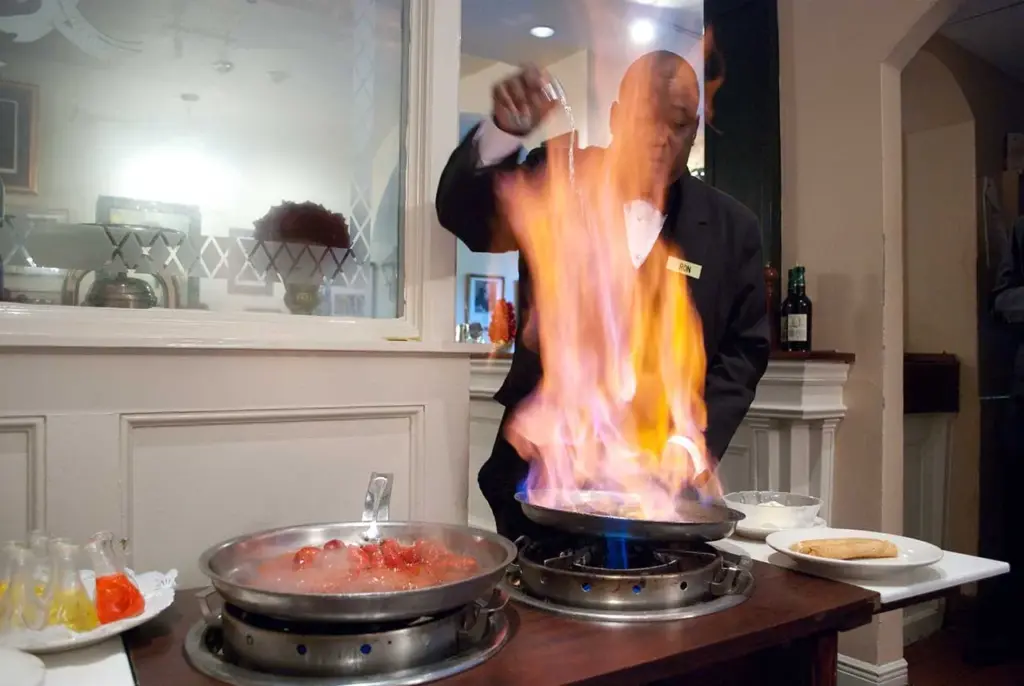
Plate service, where dishes are fully prepared in the kitchen and simply delivered to the table, has become the default in most restaurants and hotels. While efficient, predictable, and cost-effective, it has had a profound and, in many ways, damaging effect on the art of service. What was once an engaging interaction between guest and server, the subtle theatre that elevated dining into an occasion, has, in many establishments, all but disappeared.
There was a time when service staff were performers in their own right. The dining room was a stage, and the guest experience was shaped not only by the food but also by the skill, confidence, and presence of those delivering it. Traditional tableside techniques such as flambéing, filleting fish, carving meats, preparing salads, or finishing sauces in front of diners added a layer of craftsmanship and excitement that simply cannot be replicated by placing a plate on a table and walking away. These moments created anticipation, engagement, and lasting memories. They brought the guest into the experience and made dining feel personal, considered, and alive.
Today, much of that has been stripped away in favour of speed and uniformity. Systems have replaced instinct, and process has overtaken personality. Restaurants and hotels, under pressure to control costs and maximise covers, have leaned heavily into plate service as the safest and most efficient model. But in doing so, they have unintentionally removed one of the most powerful tools they had, the ability to connect with the guest through skilled, confident, and expressive service.
As a result, a generation of service professionals is emerging without ever having been exposed to, let alone trained in, these foundational techniques. Young servers are progressing into supervisory and managerial roles, having never mastered the basics of classical service. They may be excellent at operating systems, handling reservations, and managing staff, but many have never been taught how to read a table, how to anticipate needs before they are voiced, or how to create a sense of occasion through their presence alone. They have not been given the opportunity to develop pride in craft because the craft itself is no longer being consistently practised.
This is not a failure of the individual; it is a failure of the industry to train, mentor, and pass on knowledge. When those in leadership positions have not themselves been trained in the art of service, it becomes almost impossible for them to teach it. The result is a cycle where standards slowly erode, not through neglect but through absence of understanding.
Meals, no matter how technically perfect the food may be, can feel mechanical and transactional when the artistry of service is absent. Plates arrive, plates are cleared, and bills are presented. Efficient, yes, but often lacking warmth, personality, and engagement. Guests may leave satisfied, but rarely inspired. And in a competitive industry, satisfaction is no longer enough. Memorable experiences are what drive return visits, recommendations, and loyalty.
This decline ties directly to the disappearance of what is often referred to as the art of the table. This skill set goes far beyond simply placing food correctly. It is about timing, knowing when to approach and when to step back. It is about coordination, ensuring a table is served seamlessly, without disruption or confusion. It is about elegance: how a plate is presented, how cutlery is handled, how a glass is placed. But more than anything, it is about awareness: reading the guest, understanding their pace, their mood, and their expectations without ever making it obvious.
The art of the table also includes knowledge and confidence. The ability to explain a dish with clarity and enthusiasm, to recommend a wine that genuinely complements the food, and to guide the guest through their experience in a way that feels natural rather than rehearsed. These are not just skills; they are the foundations of true hospitality. And yet, in many modern operations, they are being replaced with scripted upselling and transactional dialogue.
Technology has also played its part. Handheld ordering systems, QR codes, and automated processes have streamlined operations, but they have also created distance. While these tools have their place, they should never replace the human connection that defines great service. Hospitality is, at its core, about people, not systems.
Managers today are often measured on labour percentages, table turnover, and revenue targets. These are important, but when they become the sole focus, something vital is lost. The dining experience becomes a numbers game rather than a craft. Training is seen as a cost rather than an investment, and the long-term impact of that mindset is clearly visible on the floor.
The art of the table remains essential, particularly in fine dining but also in any establishment that aspires to stand out. It transforms a meal from simple consumption into an experience. It communicates care, attention to detail, and respect, not only for the cuisine, but also for the guest. It creates moments that cannot be replicated by efficiency alone.
Even in contemporary settings, there is a strong argument for reintroducing elements of traditional service. Not necessarily in a rigid or outdated way, but in a manner that fits the style and pace of the operation. Small touches, finishing a dish at the table, engaging with the guest, and demonstrating knowledge and confidence can make a significant difference. These are the details that guests remember.
Without deliberate training, mentorship, and a willingness to invest in people, these skills will continue to disappear. And once they are gone, they are incredibly difficult to rebuild. The industry risks losing not just techniques, but an entire philosophy of service.
Ultimately, the question is not whether plate service is right or wrong; it clearly has its place. The question is whether the industry is willing to recognise what has been lost along the way and whether it has the appetite to bring it back. Because without the art of service, hospitality becomes functional rather than exceptional, and that is a compromise the industry should not be willing to accept.
Is plate service always a problem? Not at all. Plate service has a legitimate place in most operations, and, done well, it can be perfectly appropriate. My concern is not with the format itself but with what has been quietly abandoned alongside it. When plate service became the default, many establishments stopped investing in the wider craft of service altogether. The technique is not the issue; the mindset that came with it is.
Can traditional tableside service work in a modern restaurant setting? Absolutely, and I would argue it is more relevant now than ever. It does not need to be formal or old-fashioned. A simple gesture, finishing a sauce at the table, carving a sharing dish in front of guests, or just engaging with genuine knowledge and warmth, can transform the experience. The key is adapting the principles to the style of the operation, not applying them rigidly.
Why are so many young service professionals entering management without these skills? Because the people training them often do not have them either. This is the core of the problem. If a head waiter has never been taught to read a table or work a guéridon, they cannot pass that knowledge on. The cycle perpetuates itself, and with each generation the baseline drops a little further. It is not a reflection of the individuals; it is a structural failure that the industry needs to own.
Is this only relevant to fine dining? No, and that is an assumption I would push back on firmly. The principles of great service, awareness, timing, genuine engagement, and knowledge apply at every level of hospitality. A casual dining restaurant that trains its staff to truly connect with guests will always outperform one that does not, regardless of price point. The craft scales. What changes is the context, not the fundamentals.
What would you say to operators who see training as a cost they cannot afford? I would ask them to consider the cost of not training. High staff turnover, poor reviews, inconsistent service, and lost repeat business are all far more expensive in the long run than a structured investment in people. Training is not a luxury; it is the foundation on which everything else sits. The operations I have seen thrive are almost always the ones that take it seriously.
Where should the industry start? With mentorship. Find the people who still carry this knowledge, the experienced maître d’s, the seasoned restaurant managers, and the veterans who learnt the craft properly, and create structured ways for them to pass it on. That does not always require budget. It requires intention, respect for the craft, and a willingness to slow down long enough to teach. The knowledge still exists. The question is whether the industry values it enough to preserve it.
.
Trevor Walford is an international restaurant service consultant and trainer with over three decades of experience in fine dining and luxury hospitality. He began his career as a commis waiter at the Ritz and Savoy hotels and trained as a butler at Buckingham Palace before progressing to restaurant management roles in hotels, restaurants, and aboard cruise ships worldwide. He now works with hospitality businesses across the globe, specialising in service standards, staff development, and mentorship. He is a passionate advocate for the craft of dining room service and the people who practise it.
If you’d like to talk through an idea or need informed guidance, you’re welcome to contact him.

Essential cookies required for the site to function. Cannot be disabled.
Cookies that help us understand how visitors use the site.
Cookies used to deliver relevant advertisements.
Privacy Policy Terms of Service