
Sustainable Schedules: Moving Beyond the 70-Hour Badge of Honour
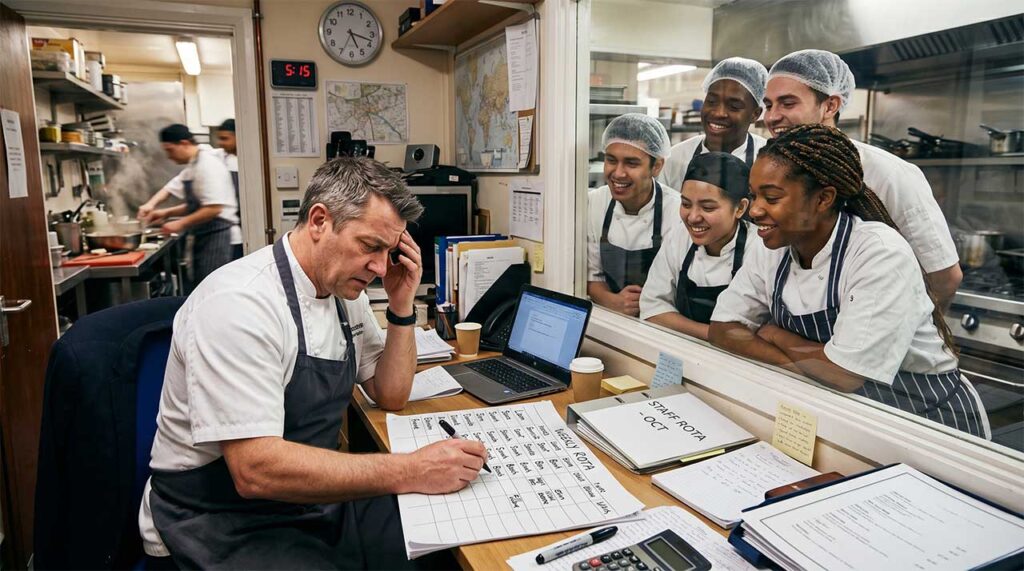
TL;DR: Long hours aren’t a mark of dedication — they’re a warning sign. Sustainable kitchen schedules protect your body, sharpen your palate, and build careers that last. Working less can mean cooking better.
The seventy-hour week is not a badge of honour. It is a warning sign, and most of us spent far too long mistaking it for the former.
I cooked my first professional service at seventeen in a hotel kitchen in Edinburgh that smelled permanently of chip fat and ambition. The head chef at the time was a red-faced Scotsman who regarded sleep as a character flaw. He worked hundred-hour weeks and expected the same from everyone beneath him. We thought he was magnificent. Looking back, he was running on cortisol and stubbornness, and so were we. By the time I was thirty, I had a bad knee, a worse back, and a deeply unhealthy relationship with the idea that suffering equalled craft. It does not. It never did.
The Myth of the Sustainable Schedule in Professional Kitchens
The hospitality industry has built entire cultures around the idea that long hours are inseparable from high standards. That if you are not exhausted, you are not serious. That rest is for people who do not really care about the food. This is, to be blunt, complete nonsense, and it has done an extraordinary amount of damage to an extraordinary number of people.
A sustainable schedule, in practical terms, means one that allows you to cook well today, tomorrow, and in ten years’ time. It means your body, your mind, and your palate are all functioning properly. It means you are not running on four hours of sleep and a Red Bull when you are supposed to be tasting a delicate fish velouté. You cannot taste properly when you are exhausted. You cannot lead a kitchen, mentor a young cook, or make genuinely considered decisions about food when your brain is running at half capacity. And yet somehow, for decades, this was considered dedication.
The term “sustainable schedule” simply means a working pattern that can be maintained over time without destroying the person maintaining it. It sounds obvious. In most industries, it would be. In professional kitchens, it has historically been treated as a radical and slightly suspicious idea.
Why the Seventy-Hour Week Became Normal
There are several perfectly boring reasons why kitchen culture landed where it did. Thin margins, inadequate staffing budgets, a hierarchy borrowed loosely from military brigades, and a kind of inherited machismo that nobody ever properly questioned. The long week was also self-reinforcing. If everyone around you was working those hours, then leaving at a reasonable time felt like betrayal. You stayed because they stayed. They stayed because you stayed. Nobody slept. The sauce reduced. The cycle continued.
There was also, and I say this with some self-awareness, a genuine romance to it. The camaraderie of a late-night kitchen, the particular exhaustion that comes after a perfect service, the strange pride in having survived something difficult. These are real feelings and I would not dismiss them. But romance does not protect your cardiovascular system or your marriage or your mental health, and we probably leaned on it too heavily as justification for conditions that were, objectively, poor.
What Moving Beyond the Badge of Honour Actually Looks Like
Changing deeply embedded culture is slow work, and anyone who tells you it happens quickly is selling something. But there are practical shifts that kitchens and individual cooks can make, and they do not require abandoning standards. They require redefining where those standards come from.
Rethinking What Commitment Looks Like
Commitment is not measured in hours. It is measured in the consistency and care of what lands on the plate. A cook who works forty-five focused hours, sleeps properly, eats well, and arrives rested will produce better food than one who works seventy hours in a fog of fatigue. This is not a controversial statement in any other skilled profession. A surgeon who worked seventy hours straight would terrify you. A pilot who had not slept properly would ground themselves. We should apply the same logic to kitchens, where precision, creativity, and sensory acuity are equally essential.
Practical Steps Towards Sustainable Schedules
These apply whether you are running a professional brigade or managing your own energy as a home cook who is taking food seriously:
- Audit your actual hours honestly. Not the hours you feel virtuous about, but the real ones. Write them down for two weeks. Most people are surprised by what they find, and not pleasantly.
- Build rest into the rota as a non-negotiable. Days off are not a reward for good behaviour. They are a structural requirement for sustained output. Treat them accordingly.
- Eat properly during service. Not a sad bread roll at half three. Real food, prepared with the same care you give your customers. A cook who is properly fed is a better cook. This is not a spa retreat philosophy; it is basic physiology.
- Separate identity from hours. The most dangerous thing in kitchen culture is the belief that your value as a cook is directly proportional to the hours you suffer. It is not. Your value is in what you make, how you think, and how you treat the people around you.
- Have the honest conversation about staffing. Overwork is frequently a staffing problem dressed up as a culture problem. If the hours are unsustainable, there is a structural reason, and it needs addressing structurally, not by asking individuals to simply endure more.
The Effect on Food Quality
Here is the part that gets me, professionally. Fatigue is the enemy of finesse. When you are genuinely tired, your knife work gets sloppy, your seasoning instincts go dull, and your palate stops registering subtlety. You stop tasting with curiosity and start tasting just to check a box. The difference between a properly seasoned dish and an overseasoned one is often tiny. When you are running on nothing, you miss it every time.
The cooks who produced the most considered, beautiful food I have ever eaten were not the ones who boasted about their hours. They were the ones who were genuinely present in the kitchen: observant, inquisitive, willing to pause and taste and adjust. Presence requires rest. There is no shortcut around that particular truth.
Frequently Asked Questions
Is it really possible to run a high-standard kitchen with shorter hours?
Yes, and there are now enough examples of it globally that the question is becoming less interesting. Several well-regarded restaurants have moved to four-day weeks or capped their hours and reported better retention, lower sick leave, and no measurable drop in quality. The assumption that quality requires suffering is simply not borne out when you look at the evidence.
What about the financial pressure on small restaurants?
This is a legitimate concern and one that deserves a serious answer rather than a dismissive one. The margins in hospitality are genuinely thin, and restructuring rotas costs money in the short term. But the cost of constant staff turnover, burnout-related mistakes, and the reputational damage of a kitchen that chews through people is also very high. The financial case for sustainability is not always obvious in the quarterly numbers, but it is there in the longer view.
How do you change the culture when it is so deeply embedded?
Slowly, and mostly by example. Senior chefs who model different behaviour, who go home at a reasonable hour and are visibly unembarrassed about it, do more to shift culture than any number of staff meetings about wellbeing. People follow what they see, not what they are told. If the person at the top of the kitchen treats rest as legitimate, the rest of the brigade will eventually follow suit.
The Bottom Line on Craft and Longevity
The cooks I most admire are still cooking in their sixties. Not because they were indestructible, but because at some point they figured out that the work required them to be well. That the food deserved a cook who had slept, who had eaten, who was present and curious and not quietly falling apart behind the pass. That is the standard worth chasing, not the number of hours on the rota.
Wear your craft as your badge. Leave the hours out of it.
- Long hours are a structural problem, not a measure of commitment or quality.
- Fatigue directly degrades the sensory acuity and precision that good cooking requires.
- Sustainable schedules are not a luxury; they are a professional and culinary necessity.
- Culture changes slowly, but senior cooks modelling healthy patterns is the most effective lever available.
- The food is better when the cook is rested. This is not philosophical. It is practical.