
Kitchen Ergonomics and Staff Mental Health
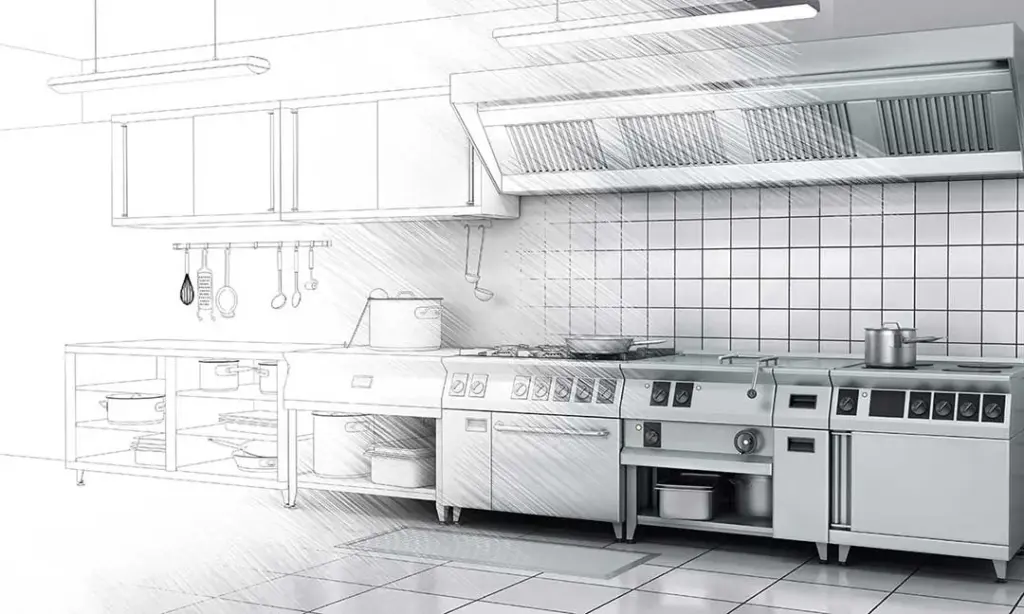
TL;DR: Kitchen design directly affects staff mental health. Poor layouts, wrong bench heights, and chaotic flow create daily physical and psychological strain. Designing kitchens around the people who use them is one of the most practical steps a business can take to protect its team.
The way a kitchen is designed has a direct and measurable effect on the mental health of the people working in it. Get the layout wrong and you are not just creating inefficiency. You are creating suffering.
I have worked in kitchens where the pass was so badly positioned that you had to pirouette past a blazing range every time you carried a plate. I have peeled vegetables hunched over a prep bench that seemed designed for someone approximately four feet tall. I have shouted orders across a kitchen so loud and chaotic that, by the end of service, I genuinely could not remember my own surname. None of this was character-building. It was just bad design dressed up as tradition.
We talk a great deal now about hospitality staff mental health. We hold panels, publish reports, and nod solemnly. What we do not talk about nearly enough is the built environment. The actual physical space where chefs, commis, and kitchen porters spend ten, twelve, or fourteen hours a day. Because if the space is wrong, everything else is harder. It really is that simple.
What Kitchen Ergonomics Actually Means
Ergonomics, briefly defined, is the science of designing a working environment to fit the people using it rather than forcing the people to contort themselves around a poorly thought-out space. In a commercial kitchen, this means bench heights, equipment placement, flow between stations, floor surfaces, ventilation, lighting, and noise levels. It is less glamorous than a new range or a gleaming pass, but it matters far more in the long run.
Poor ergonomics is not just a physical problem. Yes, it causes bad backs, sore knees, and repetitive strain injuries that accumulate quietly over years. But it also causes frustration, anxiety, and a low-grade, grinding sense of helplessness. When your environment works against you, when every shift is a small battle against your own workspace, it wears you down in ways that go well beyond muscle fatigue.
Kitchen Ergonomics and Mental Health: The Connection We Keep Ignoring
There is a reason why highly stressed kitchen environments have such alarming rates of burnout, anxiety, and substance abuse. Part of that is cultural: the old brigade mentality, the macho posturing, and the praise withheld like good wine at a bad party. But a significant part is structural. The environment itself creates and amplifies stress.
Consider noise. A poorly ventilated commercial kitchen, with hard surfaces everywhere and equipment running at full tilt, can easily reach 85 to 90 decibels during service. That is roughly equivalent to standing next to a lawnmower for eight hours. Sustained exposure to that level of noise raises cortisol, impairs concentration, increases irritability, and makes communication between staff harder and more fraught. You shout, they shout back, misunderstandings happen, and tempers fray. The kitchen feels dangerous even when no actual danger exists.
Or consider space and flow. When stations are cramped and the traffic routes through the kitchen are badly designed, collisions happen. Hot pans pass close to faces. Staff are constantly in each other’s way. This creates a persistent background anxiety, a low hum of ‘something might go wrong at any moment’, that is exhausting to sustain over a long shift. It is not dramatic. It is just relentless, and relentless is often worse than dramatic.
Chef Workplace Stress and the Role of Physical Environment
Chefs are not, as a profession, famous for complaining about conditions. The culture has historically rewarded people who put up and shut up, which is part of why so many talented cooks left the industry entirely during and after the pandemic. But when you ask chefs what actually makes a shift feel manageable versus unbearable, the physical environment comes up again and again.
A bench at the wrong height. A walk-in fridge positioned so that every trip to it requires cutting across the main cooking line. A hand-washing sink that somehow ended up in the least convenient possible location, meaning people avoid it (which is also a food safety issue, but that is a different conversation). These things seem small. They are not small. Over the course of a week, they add hours of unnecessary friction, physical strain, and minor but cumulative stress to every single shift.
Principles of a Sane Ergonomic Kitchen Layout
Good ergonomic kitchen design is not expensive architecture. A lot of it is common sense, applied honestly. Here are the principles that actually matter in practice.
- Bench height is non-negotiable. Standard prep bench height is around 900mm, but this assumes a cook of average height. Adjustable benching is ideal. Fixed benching should at least be set at a height where your elbows are slightly bent when your palms rest flat on the surface. Hunching over a low bench for six hours destroys the lower back and, eventually, the will to live.
- Create clear traffic routes. The kitchen should have defined paths for food in, food out, waste out, and staff movement. These routes should not cross each other constantly. Collisions are not just dangerous; they are mentally exhausting because every near-miss is a small spike of adrenaline that your nervous system has to process.
- Reduce noise where possible. Acoustic panels on walls and ceilings are not a luxury. They are a genuine intervention for staff mental health. Rubber matting on floors absorbs impact noise. Quieter extraction systems exist. None of this is radical; it simply requires that noise be treated as a serious workplace hazard rather than an accepted soundtrack.
- Light the workspace properly. Poor lighting causes eye strain and, more insidiously, affects mood. A kitchen that feels dingy and oppressive creates a very different psychological environment from one that is well-lit and clear. Natural light, where it can be incorporated, is a genuine benefit to restaurant staff well-being.
- Give people a place to stop. A proper break area, separated from the kitchen, is not a frivolity. The ability to sit somewhere quiet, eat something, and briefly not be in the kitchen is essential for mental recovery during a long service. Kitchens that do not have this, where staff eat standing at the pass or in a corridor, are communicating something about how they value their people.
What Owners and Head Chefs Can Do Right Now
Not everyone is building a kitchen from scratch. Most of us are working with what we have, inherited from someone else’s decisions made years ago under budget pressure. That does not mean nothing can be done.
Walk your kitchen during a quiet moment and actually look at the flow. Where do people bunch up? Where are the awkward corners? Where is the noise worst? Where is the light the worst? You do not need a consultant to tell you these things. You need twenty minutes and honest eyes.
Small interventions matter. Anti-fatigue matting at prep stations costs very little and makes a genuine difference to people standing for long periods. A rubber grip on a too-low bench can be raised slightly with a platform. Hand-washing stations can sometimes be relocated with a small amount of plumbing work that pays for itself in food safety compliance alone. None of this is glamorous. All of it communicates to your staff that their physical wellbeing is taken seriously.
Frequently Asked Questions
Does kitchen design really affect mental health, or is it just about physical safety?
Both are connected. Physical discomfort and constant low-level hazard create psychological stress. A kitchen that hurts to work in is also a kitchen that is stressful to be in. The physical and mental are not separate systems; they inform each other constantly.
Is improving commercial kitchen design expensive?
A full redesign is a significant investment, yes. But many of the most effective interventions, matting, lighting improvements, acoustic treatment, and sensible traffic routing are relatively low cost and can be implemented in existing kitchens. The expense of not doing them, staff turnover, sick days, and burnout is almost certainly higher.
How do I convince kitchen owners that hospitality staff mental health is linked to design?
Frame it as a business case if the human case does not land. High staff turnover, recruitment costs, and the damage that burnt-out chefs do to the quality of the food are all directly affected by working conditions. A kitchen that is designed for the people in it retains good people. That is not sentimentality. That is economics.
Professional kitchens are extraordinary places. They are also, if we are honest, frequently designed with very little thought for the humans inside them. The culture is changing, slowly, and the conversation about mental health in hospitality is more open than it has ever been. But culture change without structural change only goes so far. You cannot talk someone into feeling well in a space that is working against them from the ground up.
Fix the space. The rest gets easier.