

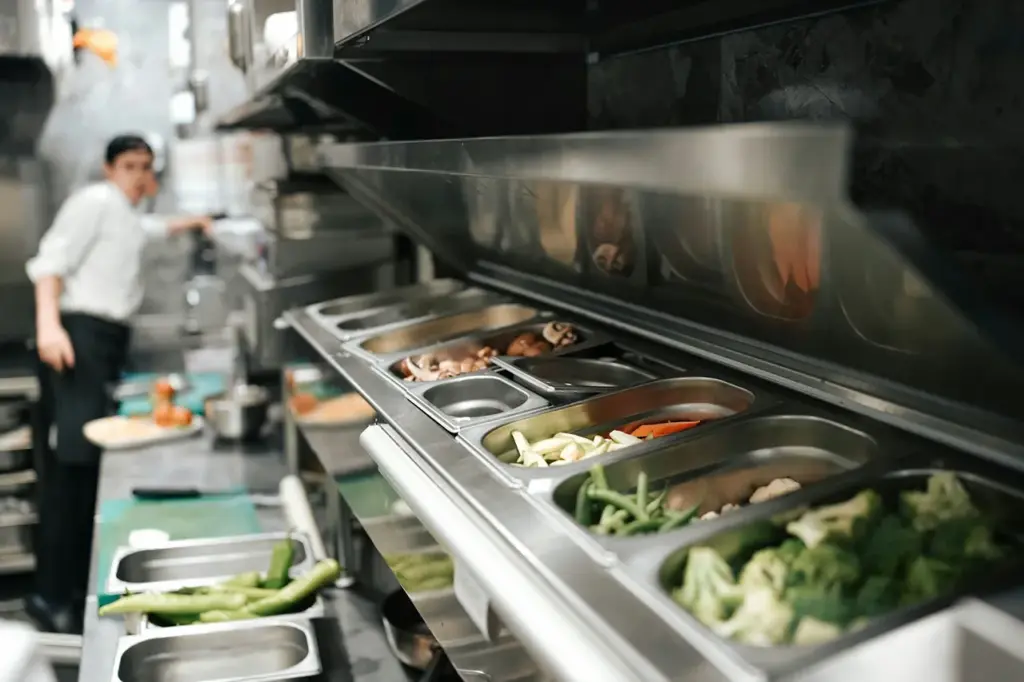
Service starts in forty minutes. Your section is half-prepped, two chefs have called in sick, and the reservation sheet shows a full house with a private party of twenty arriving at seven. If your mise en place isn’t locked in before that first ticket drops, you’re not running a kitchen ; you’re firefighting. Every experienced chef knows this feeling, and every experienced chef knows there’s only one thing standing between controlled service and complete chaos: a mise en place system that actually works.
Most kitchens treat mise en place as a prep checklist. The best kitchens treat it as a management philosophy. There’s a significant difference, and it shows up directly in your food cost, your GP margin, and the mental state of your brigade at the end of a double shift.
The phrase translates literally as “everything in its place,” but in a professional kitchen, it means something far broader than having your brunoise cut and your stocks reduced. True mise en place is a framework for how your kitchen thinks, plans, and executes, from the moment your first chef clocks in to the moment the last cover goes out.
When you build mise en place into your management structure, you’re creating accountability at every level. Each section owns its prep. Each chef knows exactly what needs to be done, in what order, and to what standard before service begins. There’s no ambiguity, no duplication of effort, and no last-minute scramble because someone assumed someone else had dealt with the hollandaise.
The kitchens that struggle with consistency aren’t usually struggling with talent; they’re struggling with systems. A strong mise en place culture means your CDP can run their section with the same precision as your sous chef, because the expectations are embedded in how the kitchen operates, not just in who happens to be standing there.
Start with your menu and work backwards. Every dish on your menu should have a prep breakdown that identifies what can be done in advance, what must be done to order, and what the critical path looks like for a busy service. This isn’t just useful for training;it’s essential for labour planning and food cost control.
Standardise your prep sheets and make them section-specific. A generic kitchen prep list is almost useless. What your larder section needs to have ready by midday is entirely different from what your pastry section needs by three o’clock. Build sheets that reflect the actual rhythm of your kitchen, including realistic time allocations based on covers expected and the complexity of your current menu.
Introduce a sign-off process. Before service begins, section leads should physically confirm their mise en place is complete and at the correct standard: temperature, quantity, and quality. This isn’t about micromanagement; it’s about removing the variables that cause service to break down. A two-minute check before service saves twenty minutes of chaos during it.
Review your mise en place system when your menu changes. Too many kitchens update their dishes without updating their prep infrastructure. If you’ve added a new sauce, a new garnish, or a new protein to the menu, your prep sheets, your storage layout, and your section responsibilities need to reflect that immediately.
Poor mise en place is one of the most underestimated drivers of food waste and inflated food costs. When prep is disorganised, a product gets overordered, incorrectly stored, or simply forgotten at the back of a reach-in until it’s past use. When sections aren’t clearly accountable for their own prep, you get duplication ; two chefs prepping the same component, or worse, neither of them prepping it at all.
A disciplined mise en place system forces you to think about yield at every stage. How much of that fish fillet is actually usable after trimming? How many portions does that batch of sauce yield? When your prep is structured and documented, these numbers become visible, and visible numbers can be managed. Kitchens that run tight GP (gross profit) margins don’t do it by accident; they do it because their prep process is precise enough to make waste an exception rather than a habit.
Batch sizing is another area where mise en place discipline pays off directly. Prepping to a consistent batch size, tied to your expected covers, means you’re not over-producing on a quiet Tuesday or scrambling to stretch product on a busy Saturday. It requires accurate forecasting, but it also requires a prep system disciplined enough to execute against that forecast reliably.
One of the most overlooked benefits of a strong mise en place culture is what it does for your team’s development. When junior chefs are taught to think in terms of mise en place; not just to follow a list, but to understand why the list exists and how it connects to service, they develop the kind of operational thinking that separates a competent cook from a chef who can actually run a section.
Use mise en place as a teaching tool. Walk your commis through the logic of why certain components are prepped in a specific order, why storage placement matters, and why timing their prep to service flow is a skill in itself. When they understand the system, they can adapt to it when things go wrong ; and things always go wrong.
For head chefs and kitchen managers, mise en place is also a useful lens for performance assessment. A chef who consistently has their section ready, at standard, before service is a chef who understands the job. A chef who is perpetually behind or whose prep quality is inconsistent is showing you something important about either their skill level or their attitude ; and both are worth addressing directly.
Mise en place also creates the conditions for delegation. If your systems are clear and your standards are documented, you can step away from a section with confidence. That’s not just good for your sanity;it’s essential if you’re going to grow as a kitchen leader rather than remaining the person who has to be everywhere at once.
The kitchens that run smoothly under pressure aren’t lucky; they’re prepared. Mise en place, done properly, is the operational backbone that makes consistent food, controlled costs, and a functional brigade possible. It’s not a concept for culinary school; it’s a live management system that should be embedded in how your kitchen thinks and works every single day.
If your current prep culture is reactive, inconsistent, or entirely dependent on the most experienced person in the room, now is the time to change that. Audit your prep sheets, rebuild your section accountability, and start treating mise en place as the management discipline it is and not an afterthought before service but the foundation everything else is built on.
If you want to tighten your kitchen systems, reduce waste, and build a brigade that can perform without you holding everything together, start with your mise en place. Get that right, and almost everything else becomes easier to manage.
Chef Ian McAndrew’s specialist eBooks and guides are available directly on ChefYesChef, including his technical titles and autobiography. If you want more practical, chef-led reading beyond this article, you’ll find the full collection here.
Chef Ian McAndrew works with chefs, businesses, and individuals on a wide range of culinary projects, from concept development to practical problem-solving.
If you’d like to talk through an idea or need informed guidance, you’re welcome to contact him.
Essential cookies required for the site to function. Cannot be disabled.
Cookies that help us understand how visitors use the site.
Cookies used to deliver relevant advertisements.
Privacy Policy Terms of Service